Editor’s Note: This video/post was originally recorded and released in May 2023. In 2025, we released an updated video on similar topics.
Suspension Isn't a "Black Art"—It’s Physics
Every time I walk into a garage or a paddock, I hear someone call suspension a "Black Art." To me, "black" means no light. It means total darkness, no hope, and no way to figure it out. That’s just sign language for bullshit.
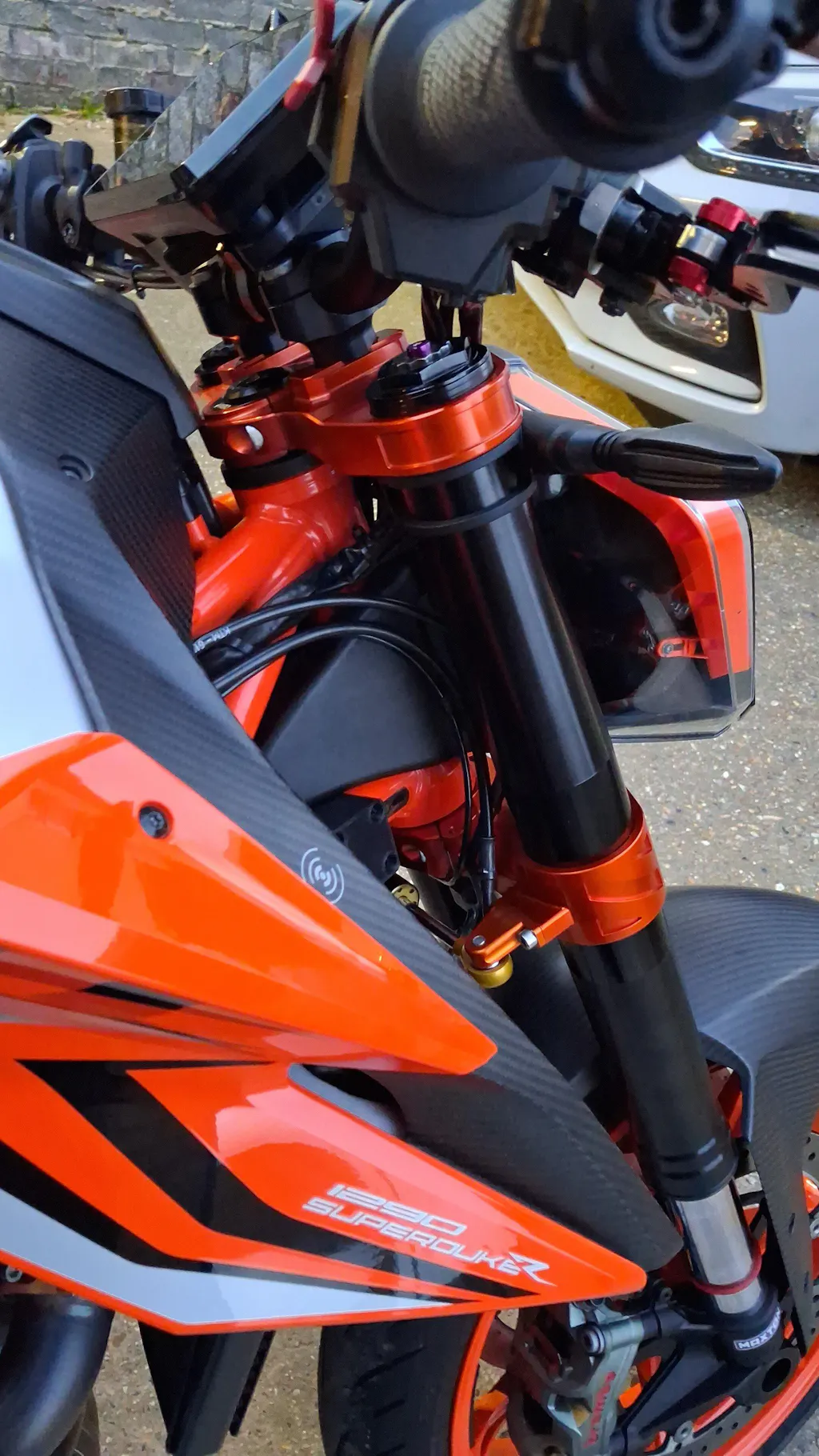
Suspension isn't black. It might be a little gray, but that’s only because there’s so much misinformation floating around online. We’re here to turn the lights on. If you understand a few basic principles of physics, you can manipulate your KTM Super Duke to be safer, faster, and—most importantly—more fun to ride.
We all want to buy the "cool" stuff first—the exhaust that screams or the carbon fiber that shimmers. But the most critical component that impacts your entire experience is the spring. Most of you will ride your motorcycle for its entire life on the stock springs, never realizing that the manufacturer built that bike for "everyone"—which means they didn't really build it for you.
The 100-Pound Dumbbell: Understanding Spring Rates
Let’s start at Ground Zero: the spring. Whether it’s in your ballpoint pen or on your $20,000 Super Duke, a spring has a rate. In the U.S., we often talk about pounds per inch.
Imagine you have a 100-pound spring. If you take a 100-pound dumbbell and set it on top, that spring compresses exactly one inch. If you add another 100 pounds, it goes two inches. It’s linear. In the metric world, we measure in Newtons per millimeter (like the 95 N/mm springs we often see).
Why does this matter? Because your motorcycle and your body are suspended on these springs. If you were bolted straight to the wheels, you’d be bouncing into the air every time you hit a pebble. The job of the suspension is to let the wheels follow the road while the bike stays steady. But to do that, you have to stay within your "window of travel."
The 2:1 Rule and Your Window of Travel
On the KTM Super Duke, the math gets interesting. Your shock usually has about 50mm of stroke—that’s the actual distance the shock body can compress. However, because of the way the linkage is designed, there is a leverage ratio. On these bikes, it’s roughly 2:1.
That means for every 1mm the shock moves, the rear axle moves 2mm. So, a 50mm shock gives you about 100mm of actual travel at the wheel.
You have to operate within that 100mm window. If you’re hanging out at the very top or the very bottom of that range, you’re looking for trouble. You want your suspension to live in a "happy place" where it has enough room to breathe, regardless of whether you're hitting a manhole cover or a ripple at 150 mph.
The Non-Negotiable Energy of a Bump
Here’s something my brain had to wrap around early in my racing career: energy is non-negotiable.
Every bump in the road has energy. If you hit a bump at 50 mph, maybe it’s 200 pounds of force. If you hit that same bump at 150 mph, it might be 700 pounds of force. That energy must be absorbed.
If your suspension is set up correctly, the spring and the valving take that hit, and you barely feel it. But if you run out of travel—if you "bottom out"—that energy doesn't just disappear. It’s still there. Since the shock can't take it anymore, the energy gets transferred directly into the tire and the frame.
Your tire, which is supposed to stay round to maintain traction and turning ability, gets squished flat. You lose the turn, you lose the grip, and usually, you lose the bike.
Bridgehampton ’96: Why "Softer" Can Be Dangerous
I learned this lesson the hard way in 1996 at Bridgehampton. If you never saw that track, it was legendary—and terrifying. It was built over an old forest, and over decades, the tree stumps under the pavement rotted away, leaving these massive, hidden "sinkhole" bumps right on the racing line.
It was a rain race, and I was running second behind Richie Alexander. I wanted the bike to feel "softer" and more compliant for the wet conditions. I backed off my compression, backed off the rebound, and I backed off the preload. I thought I was making the spring softer. I was wrong.
Coming into Echo Valley, a heavy braking zone, I pulled out to pass Richie. I hit the brakes, the forks dove, and because I had backed off my preload, I was already sitting too low in my window of travel. I hit one of those hidden tree-stump bumps, bottomed the forks instantly, and the front tire couldn't take the non-negotiable energy.
I went down, took Richie with me, and ended up in the deep white sand. I always joke that I never got to meet Michael Jordan because I took out the guy who ended up managing his race team—all because I didn't understand my travel window.
Stop the Compromise
Most of us are riding a compromise. We try to use preload to fix ride height or "feel," but all we’re doing is moving our window of travel closer to a crash.
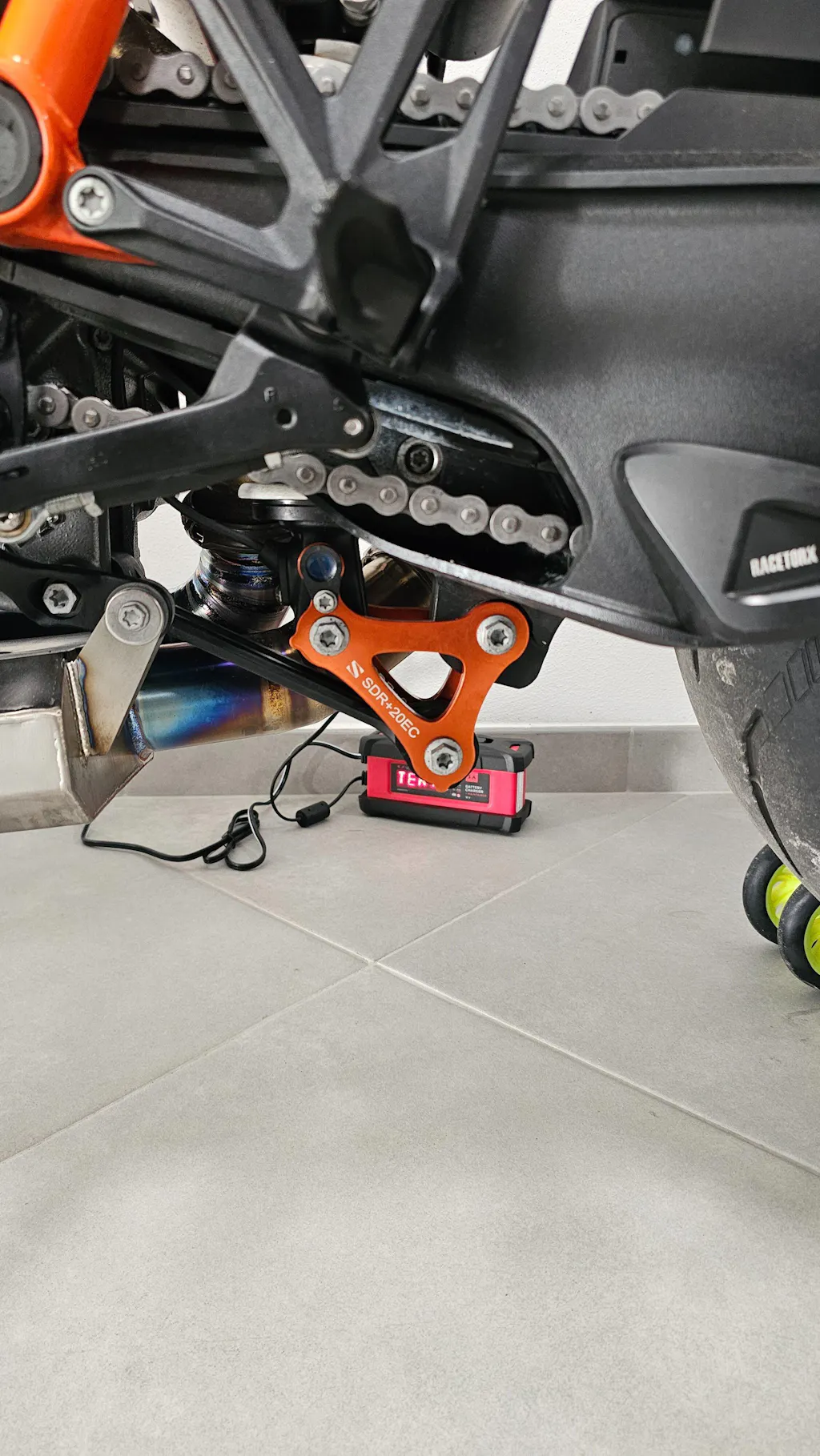
If you want the bike to handle correctly, you have to get the geometry right mechanically. That’s why we engineered the Super Link and the Sport Link. These aren't just "parts"; they are the mechanical solution to the KTM's factory limitations. They allow you to put the bike in the aggressive stance it needs to turn, without forcing your shock to live outside its happy place.
Don't be like '96 Gogo. Don't ride a compromise. Understand your math, find your window, and keep your tires round.
The Masterclass
If you want to see me break this down on the chalkboard and explain the 2:1 ratio in more detail, watch the full masterclass below. This is just the beginning of getting the light turned on in the room.
Watch the Video: Debunking The Myths of a "Black Art": Motorcycle Suspension Spring Rates, Sag, Travel & Preload
Ready for more? Once you’ve got the basics of travel and spring rates down, head over to Part 2 of this Masterclass, where we dive into the controversial truth about preload and why everything you’ve been told about "softening" your springs is probably wrong.